Performance Improvement Plan (PIP) Governance Framework
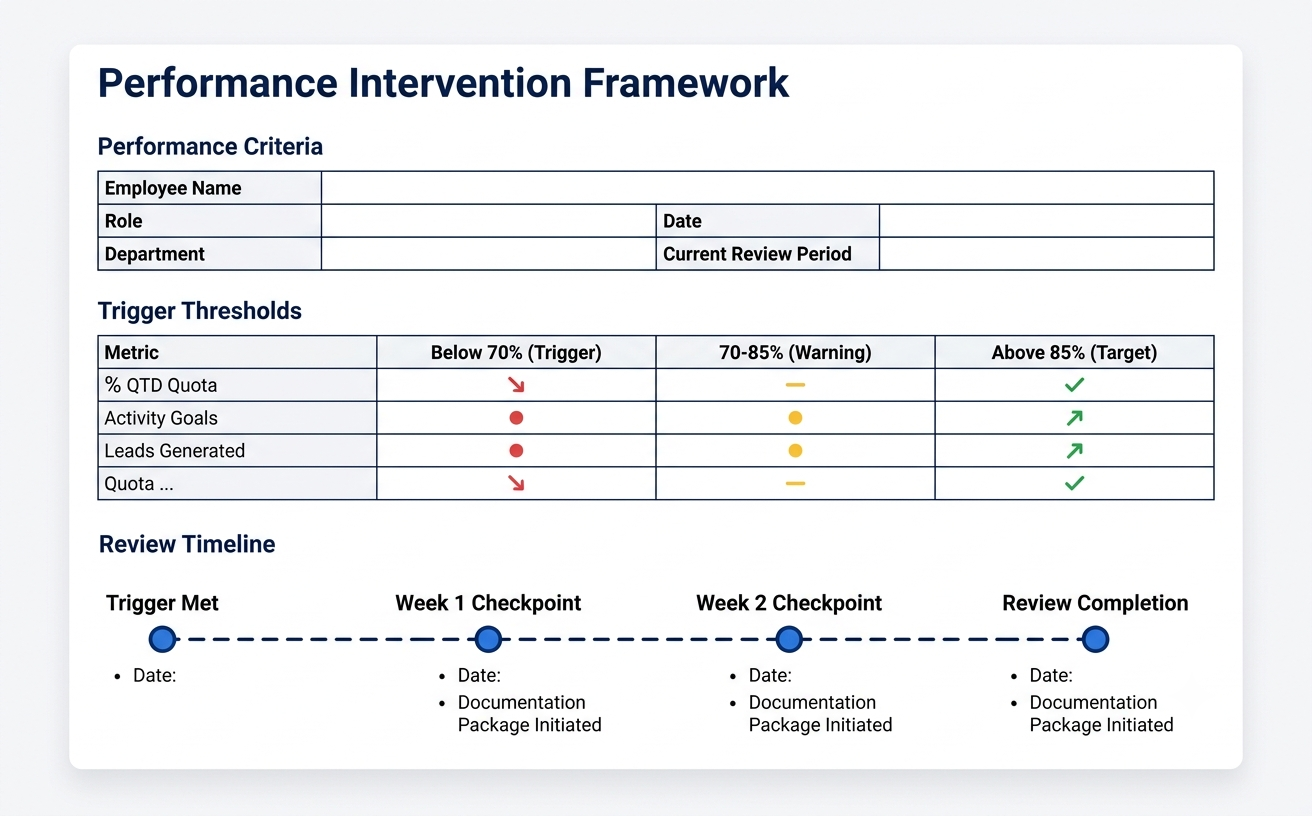
Governance framework defining objective trigger thresholds, structured intervention timelines, daily activity expectations, and documentation standards for performance improvement plans across the SDR organization. Initiated and drafted by me when no formal PIP process existed.
System Overview
When I joined the organization, no formal PIP structure existed. Performance interventions were handled inconsistently across managers with no documented trigger criteria, timelines, or activity expectations - creating risk around fairness, accountability, and HR compliance.
I drafted the first PIP framework from scratch, worked through revisions with management, and drove it to publication. The finalized document was adopted by leadership and HR, published to Confluence as official organizational documentation, and integrated into Canvas as part of the new hire onboarding module.
This framework was developed as part of the broader SDR governance initiative. See: CRM Outreach Eligibility & ROE Compliance Reporting.
Structural Gap
- No formal PIP structure existed anywhere in the organization.
- No objective quota threshold triggers defined when intervention was required.
- Performance interventions varied by manager with no consistent standard.
- No documented timeline, checkpoint structure, or activity expectations.
- No written template to align manager, rep, and leadership expectations.
Framework Design
- Trigger Thresholds - New-hire BDRs: 3-month ramp period at 50% quota expected; below 35% after ramp triggers a quarterly PIP. Established reps: below 50% quota triggers a Month-to-Month PIP; below 80% triggers a Quarterly PIP.
- PIP Duration Structure - 30, 60, or 90-day timelines depending on severity of the performance gap, with weekly and monthly checkpoint reviews built in.
- Daily Activity Expectations - BDRs on PIP required to meet: 80 outbound calls/day, 20 personalized emails/day, 2 meetings booked/week, daily activity report submission, and mandatory weekly 1-on-1 with Team Lead.
- Exit Criteria - BDR exits PIP by achieving at least 70% quota attainment and demonstrating consistent engagement with improvement initiatives.
- Aggravating & Mitigating Factors - Defined conditions for escalation to termination (e.g., two consecutive quarters below 50%, failure to engage) and documented mitigating exceptions (e.g., medical leave, market conditions, positive contributions outside quota).
- Documentation Package - Standard written template with signature requirements for BDR, manager, and director, aligning all parties on expectations and accountability.
Tools
- Confluence (official documentation repository)
- Canvas (new hire onboarding integration)
Scale
- Primary users: SDR leadership, management, and HR
- Scope: team-wide performance governance across 11–15 BDRs/SDRs
- Adoption: approved by leadership and HR, published to Confluence and Canvas
Operational Impact
- Introduced the first objective, documented performance intervention standard in the organization.
- Eliminated subjective manager-by-manager variation in escalation decisions.
- Strengthened accountability for both reps and managers through written documentation.
- Created an HR-aligned framework that could be enforced consistently across the team.
- Integrated into new hire onboarding so performance expectations were set from day one.
Future Improvements
- Build a dashboard tracking active PIP timelines and checkpoint completion.
- Automate quota attainment monitoring to surface trigger conditions without manual review.
- Expand framework to cover AE and CS performance governance.