← All Projects

CRM Outreach Eligibility & ROE Compliance Reporting

SDR Governance Framework
Eliminated duplicate demo bookings, reduced cross-team ownership disputes, and shifted the SDR organization from informal interpretation to enforceable outreach rules across four product lines.

Comprehensive governance framework built to control lead ownership, define cross-product outreach boundaries, and standardize outreach eligibility evaluation across an 11–15 person SDR team. Enforced through a combination of Salesforce automation, decision framework documentation, and Confluence-hosted training materials.

System Overview

As the sole Team Lead overseeing 11–15 SDRs supporting 7–15 Account Executives across four product lines - Verity, Panorama, Lumina, and EqualGround - and two regions (San Jose and Toronto), no enforceable governance structure existed to control lead ownership lifecycle, cross-product outreach boundaries, or demo booking conflicts.

As team size and product complexity increased, ambiguity created real operational risk: duplicate demo bookings, internal AE/SDR disputes, revenue attribution confusion, and unenforceable performance standards. This project introduced a structured governance layer combining Salesforce automation, decision framework documentation, and published training materials to shift the organization from informal interpretation to enforced rules.

The PIP framework was developed as part of this initiative. See: Performance Improvement Plan Governance Framework.

Governance Decision Framework

Rules of Engagement policies were operationalized through a structured decision framework used by SDRs to determine whether outreach into an account or lead was permitted.

The framework standardized how representatives evaluated account status, existing opportunities, and lead ownership before initiating prospecting activity. Workflows were documented, reviewed with upper management, and published to Confluence as official organizational reference material.

ROE Decision Workflows

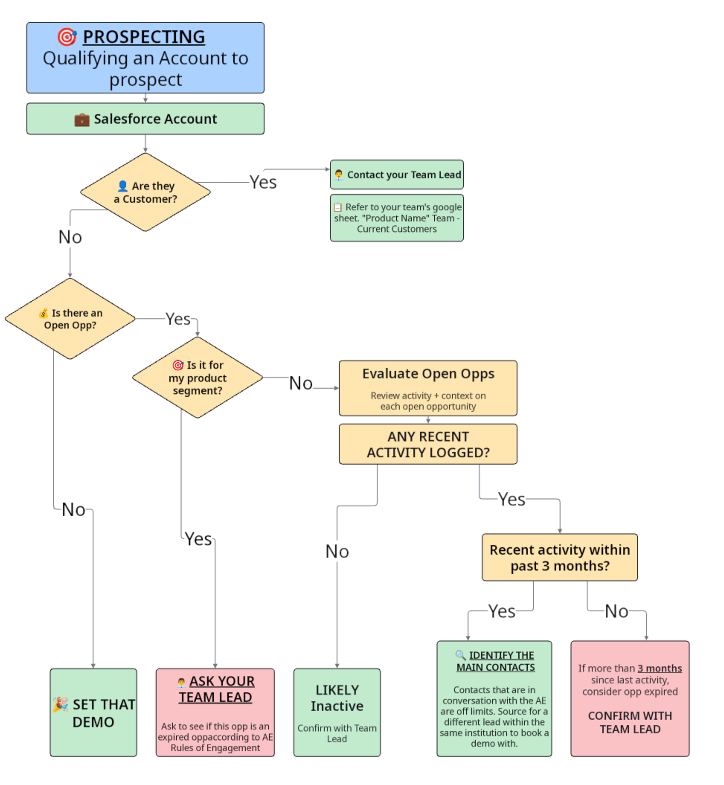
Account Qualification Workflow

Process used when evaluating whether an account is eligible for prospecting based on customer status and opportunity activity.

Account Qualification Workflow

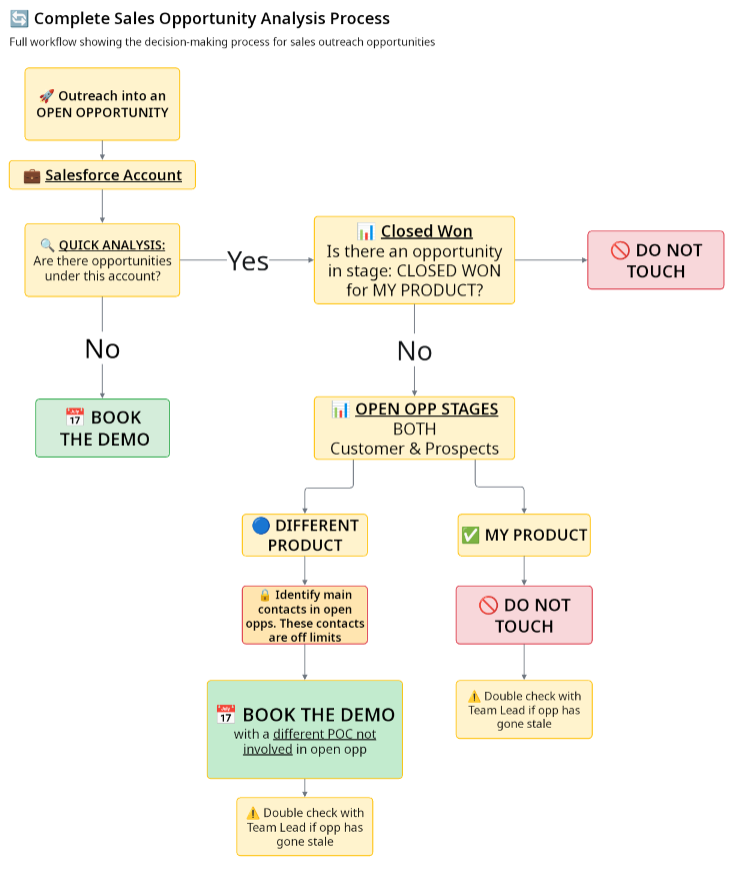
Opportunity Conflict Analysis

Decision framework used when an account already contains open opportunities. SDRs must evaluate product alignment and avoid engaging contacts actively involved in ongoing deals.

Opportunity Analysis Workflow

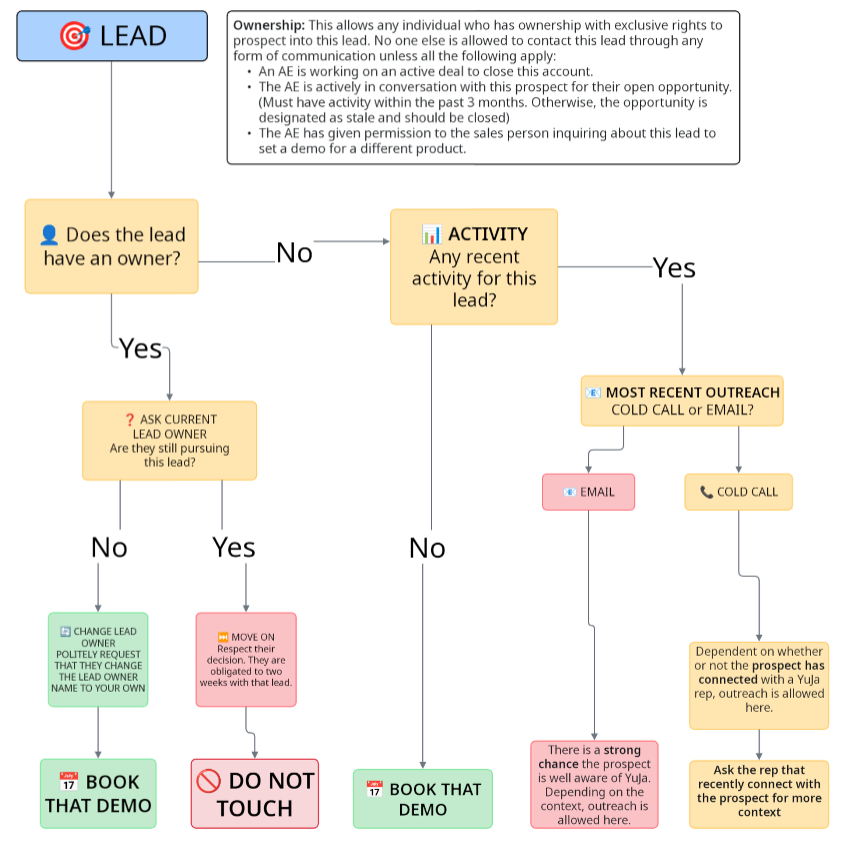
Lead Ownership Evaluation

Lead ownership rules govern which representatives may contact a prospect. Ownership and recent activity must be verified before initiating outreach.

Lead Ownership Workflow

Structural Gap

  • SDRs could self-assign leads indefinitely with no expiration or reassignment logic.
  • Multiple product teams could independently contact the same institutional accounts.
  • No standardized method existed for determining when outreach conflicted with active opportunities.
  • Contacts involved in open deals were sometimes contacted by other product teams.
  • No enforceable performance accountability framework existed for the SDR organization.

Architecture

  • 14-Day Lead Ownership Enforcement - Salesforce record-triggered Flow monitored lead assignment timestamps. At day 14, ownership was automatically removed, the lead was labeled "Expired," and returned to the eligible pool. No manual override allowed before expiration.
  • Opportunity Guardrail Rules - Formal decision tree governing open opportunity stage checks, Closed Won protections, active contact protection logic, and a 3-month recency activity rule for cross-product eligibility.
  • Cross-Product Outreach Logic - Defined when Product B outreach was permitted into accounts with active Product A opportunities, including which contacts were protected and when AE alignment was required.
  • Coordination Escalation Layer - SDRs escalate stale opportunities or ambiguous ownership cases to team leadership rather than making unilateral outreach decisions.
  • Documentation & Training Layer - Full governance framework published to Confluence as official reference documentation and integrated into Canvas as a new hire onboarding module.
ROE Evaluation Workflow Account Evaluated → Customer Status Verified → Opportunity Presence Checked → Active Contact Protection Applied → Lead Ownership Verified → Outreach Permitted or Escalated

Tools

  • Salesforce CRM
  • Salesforce Flow Builder
  • Confluence (governance documentation)
  • Canvas (new hire onboarding integration)

Scale

  • Team size: 11–15 SDRs, 7–15 Account Executives
  • Product lines: Verity, Panorama, Lumina, EqualGround
  • Regions: San Jose + Toronto
  • Objective: replace informal interpretation with enforceable outreach governance

Operational Impact

  • Eliminated duplicate demo booking incidents across product teams.
  • Reduced cross-team ownership disputes and AE/SDR escalations.
  • Standardized outreach eligibility evaluation across all four product lines.
  • Created enforceable lead ownership boundaries with system-level expiration logic.
  • Improved prospect experience through coordinated, non-conflicting outreach.

Future Improvements

  • Automate opportunity activity detection to surface stale deals without manual review.
  • Introduce CRM flags for restricted contacts directly on account layouts.
  • Build outreach eligibility indicators surfaced in the SDR prospecting workflow.